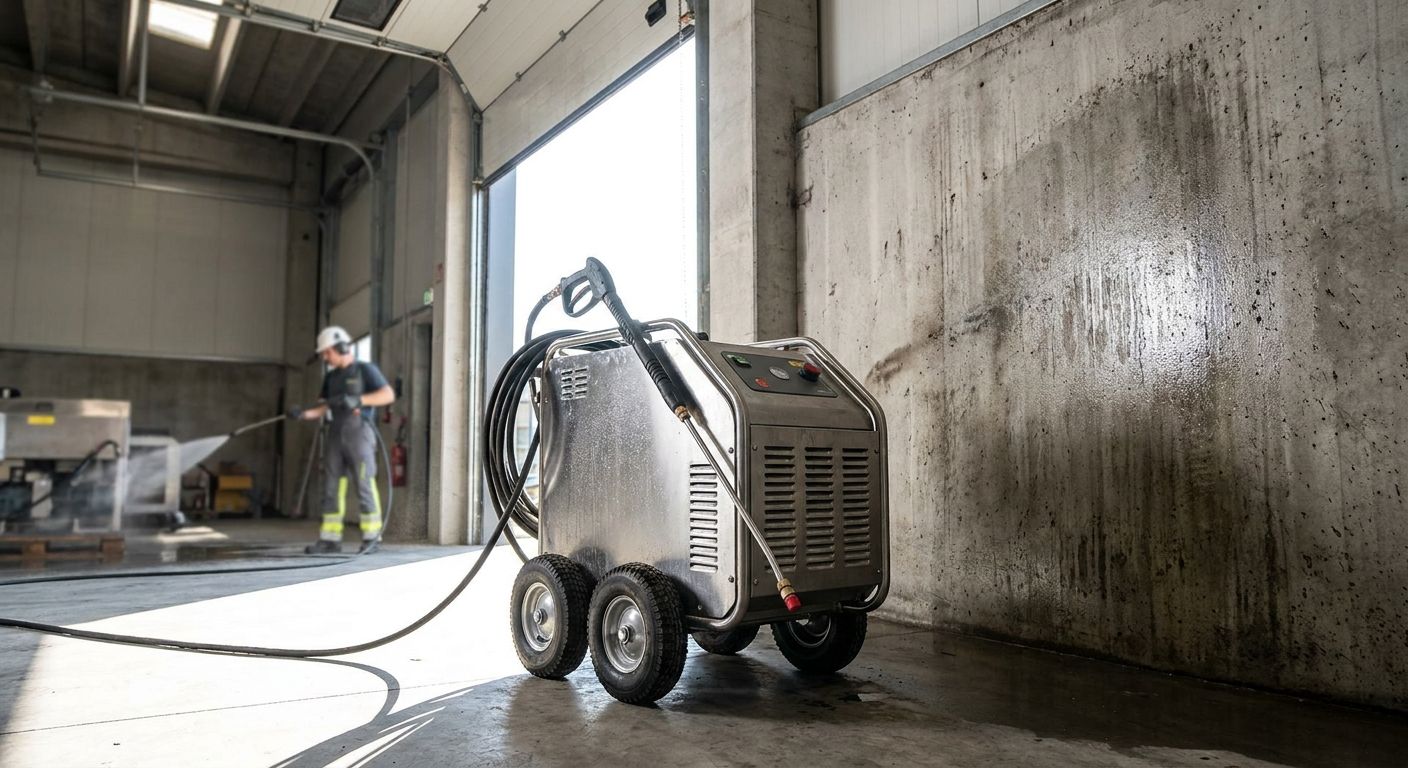
Choosing the right idropulitrice professionale (professional pressure washer) for an industrial site comes down to three things: water temperature, pressure range, and how the machine fits your daily workflow. This guide ranks seven professional pressure washer categories by use case for 2026, so you buy the machine that matches your plant instead of the one with the biggest number on the spec sheet.
- Hot water professional pressure washers win for degreasing and oil removal in industrial plants in 2026.
- Cold water units cover most general facility washdown; skip hot water if grease isn't the problem.
- Mobile trailer units fit multi-site field service; stationary systems fit fixed production lines.
- Petrol units solve off-grid outdoor jobs; battery-electric units solve indoor noise restrictions.
- ARCE Equipment, a Bologna-based Kärcher Professional service center since 1973, configures and services all seven categories.
Why this matters
A pressure washer mismatched to the job either wastes energy heating water you don't need, or fails to cut grease fast enough and adds cleaning hours to every shift. Industrial buyers in 2026 are still defaulting to "buy the highest bar rating" instead of matching temperature and duty cycle to the actual soil type on the floor.
ARCE Equipment, the authorized Kärcher Professional service center in Bologna, sees this mismatch constantly: plants running cold water units on baked-on grease, or hot water systems on jobs that never needed heat in the first place. Getting the category right before the model is what actually cuts cleaning time.
What makes the best professional pressure washer
- Pressure range matched to the soil type (light dust vs. baked grease vs. paint/rust removal)
- Water temperature capability — cold water for general washdown, hot water for oil and grease
- Duty cycle — how many continuous hours the pump and burner can run per shift
- Power source fit — electric, petrol, or diesel depending on site access and ventilation
- Mobility — stationary for fixed stations, mobile or trailer-mounted for multi-site work
- Local service and parts availability — downtime on an industrial line costs more than the machine
Professional pressure washers at a glance
| Category | Best For | Standout Feature | Key Limitation |
|---|---|---|---|
| Hot water professional pressure washer | Degreasing and oil removal | Heats water up to roughly 68C (155F) | Higher running cost, needs fuel or power for the burner |
| Cold water professional pressure washer | General facility and vehicle washdown | Lower operating cost, simpler maintenance | Struggles with baked-on grease and oil |
| Mobile trailer-mounted pressure washer | Multi-site field service | Self-contained, tows between locations | Needs a tow vehicle and storage space |
| Stationary pressure washer system | Fixed production-line cleaning stations | Can run on a schedule or automated cycle | Not portable, fixed installation cost |
| Petrol-powered pressure washer | Off-grid outdoor sites | No electrical hookup required | Exhaust fumes rule out indoor use |
| Battery-powered pressure washer | Indoor, noise-restricted environments | Quiet, no exhaust, cordless | Shorter run time between charges |
| Ultra-high-pressure industrial system | Surface prep and heavy descaling | Pressures well above standard industrial range | Overkill and higher risk for routine washdown |
1. Hot water professional pressure washer: best for degreasing and oil removal
Hot water units heat the outflow to roughly 68C (155F), which breaks down grease and oil far faster than cold water alone. This is the category ARCE Equipment configures most often for machine shops, food processing lines, and vehicle fleet depots that deal with caked-on oil daily.
Hot water pressure washer pros:
- Cuts cleaning time on grease and oil dramatically compared to cold water
- Handles food-grade and automotive degreasing in one pass
- Works with lower detergent volumes because heat does part of the job
Hot water pressure washer cons:
- Higher fuel or energy cost to run the burner
- More components (burner, boiler) mean more service points
Best for: plants with daily grease, oil, or food residue on hard surfaces. Verdict: Buy if grease removal is a recurring problem.
2. Cold water professional pressure washer: best for general facility washdown
Cold water units cover the bulk of routine industrial cleaning — floors, vehicles, equipment exteriors, loading docks — without the running cost of a burner. Pressure typically sits in the 100-250 bar range depending on the pump.
Cold water pressure washer pros:
- Lower running cost and simpler maintenance than hot water models
- Fewer parts to service, less downtime risk
- Fits most general industrial washdown tasks out of the box
Cold water pressure washer cons:
- Slower on baked-on grease and oil compared to hot water
- May need more detergent to compensate for lack of heat
Best for: facilities without a heavy grease or oil problem. Verdict: Buy as the default unless your soil load says otherwise.
3. Mobile trailer-mounted pressure washer: best for multi-site field service
A trailer-mounted unit carries its own pump, water tank, and often a generator, so it tows between job sites without depending on the client's power or water supply. This fits contractors, equipment rental fleets, and service companies covering multiple locations in a day.
Mobile trailer pressure washer pros:
- Self-contained: no dependency on site power or water
- Covers multiple job sites in one shift
- Can carry hot or cold water configurations
Mobile trailer pressure washer cons:
- Requires a tow vehicle and parking/storage space
- Higher upfront cost than a stationary unit of similar output
Best for: field service operations covering more than one site per week. Verdict: Buy if you're currently trucking a fixed unit around.
4. Stationary pressure washer system: best for fixed production-line cleaning stations
Stationary systems are plumbed into a fixed cleaning station and often integrated into a plant's washdown schedule or automated cycle. They fit facilities where the same equipment gets washed in the same spot every shift.
Stationary pressure washer pros:
- Can run on a fixed schedule with minimal operator input
- Plumbed directly into water and drainage, no manual setup
- Lower per-cycle labor cost over time
Stationary pressure washer cons:
- Zero mobility — fixed to one location
- Installation cost and plumbing work up front
Best for: plants washing the same equipment or vehicles at the same station daily. Verdict: Buy for high-frequency, fixed-location cleaning.
5. Petrol-powered pressure washer: best for off-grid outdoor sites
Petrol and diesel-driven units run without an electrical connection, which matters on construction sites, farms, and outdoor yards where power isn't available. They trade quiet operation for independence from the grid.
Petrol pressure washer pros:
- No electrical hookup needed
- Runs anywhere with fuel access
- Typically higher raw power output than battery units
Petrol pressure washer cons:
- Exhaust fumes rule out indoor or enclosed-space use
- Louder and heavier than electric alternatives
Best for: outdoor sites without grid power. Verdict: Buy only if grid access is genuinely the constraint — otherwise electric wins on cost and noise.
6. Battery-powered pressure washer: best for indoor, noise-restricted environments
Battery and compact electric units solve the opposite problem: indoor spaces, noise-sensitive facilities, or areas where fumes from a petrol engine aren't acceptable. They're the smallest category on this list and the easiest to move by hand.
Battery pressure washer pros:
- No exhaust, safe for enclosed and indoor spaces
- Quiet enough for occupied facilities
- Cordless, easy for one person to move and operate
Battery pressure washer cons:
- Shorter run time before a recharge
- Generally lower pressure output than mains-powered units
Best for: indoor cleaning where noise or exhaust is restricted. Verdict: Hold unless indoor/noise constraints actually apply to your site — otherwise a corded electric unit runs longer.
7. Ultra-high-pressure industrial system: best for surface preparation and descaling
Ultra-high-pressure systems push well past the standard 100-250 bar industrial range and are built for surface preparation, rust removal, and heavy descaling rather than routine washdown. This is a specialist category, not a general-purpose buy.
Ultra-high-pressure system pros:
- Strips paint, rust, and scale that standard units can't touch
- Reduces or eliminates chemical stripping in some applications
Ultra-high-pressure system cons:
- Overkill and a safety risk for routine cleaning tasks
- Higher cost and more operator training required
Best for: surface prep and descaling jobs specifically. Verdict: Skip unless surface prep or descaling is a defined, recurring job on your line.
Get the right pressure washer configured
ARCE Equipment sizes and services Kaercher Professional units for industrial sites in Bologna.
How we ranked
Each category was scored against the six criteria above: pressure range, temperature capability, duty cycle, power source fit, mobility, and local service availability. No category wins across every criterion — that's the point. A plant with a grease problem and a plant washing trucks outdoors need different machines, not the same machine at different price points.
Which professional pressure washer should you choose?
If grease and oil are a daily problem, buy hot water first — it's the single biggest time saver on this list. If your washdown is general facility or vehicle cleaning, a cold water unit covers it at lower running cost. Everyone else should match power source and mobility to the site, not the other way around: mobile trailer units for multi-site work, stationary systems for fixed stations, petrol for off-grid outdoor jobs, and battery-electric for indoor or noise-restricted spaces in 2026.
FAQ
What's the best professional pressure washer for industrial grease removal?
A hot water professional pressure washer, heating water to roughly 68C (155F), cuts grease and oil far faster than cold water units. This is the category to buy first if grease is a recurring problem on your floor.
Is a hot water pressure washer better than cold water for industrial use?
It depends on the soil type: hot water wins on grease and oil, cold water wins on running cost for general washdown. Most facilities without a heavy grease problem don't need to pay for hot water.
How much pressure does an industrial pressure washer need?
Standard industrial pressure washers typically run 100-250 bar, which covers most facility, vehicle, and equipment cleaning. Ultra-high-pressure systems above that range are reserved for surface prep and descaling, not routine washdown.
Can you use a petrol pressure washer indoors?
No. Petrol and diesel-powered units produce exhaust fumes that make them unsafe for enclosed or indoor spaces. Battery-powered or corded electric units are the correct choice indoors.
What's the difference between mobile and stationary pressure washer systems?
Mobile trailer-mounted units tow between job sites and carry their own water and power supply. Stationary systems are plumbed into one fixed location and fit facilities that wash the same equipment at the same station every shift.
How long does a battery-powered pressure washer run before recharging?
Run time varies by battery capacity and pressure setting, and is generally shorter than corded electric or petrol alternatives. Battery units are best suited to indoor jobs where noise and exhaust matter more than continuous run time.
Who services industrial pressure washers in Bologna?
ARCE Equipment is an authorized Kaercher Professional service center in Bologna, serving industrial and commercial clients since 1973. It configures, sells, and services hot water, cold water, mobile, and stationary pressure washer systems.
One last thing
The category that gets skipped most often isn't the cheapest one — it's the right one. Plants running a single all-purpose cold water unit across grease, general washdown, and outdoor lots are paying in labor hours what they'd save in equipment cost by splitting the job across two machine types. ARCE Equipment, working as an authorized Kaercher Professional service center since 1973, configures both hot and cold water professional pressure washer setups for exactly that reason: matching the machine to the soil, not the other way around.